Paid vs Organic Real Estate Leads: Which Actually Costs Less Per Closing?
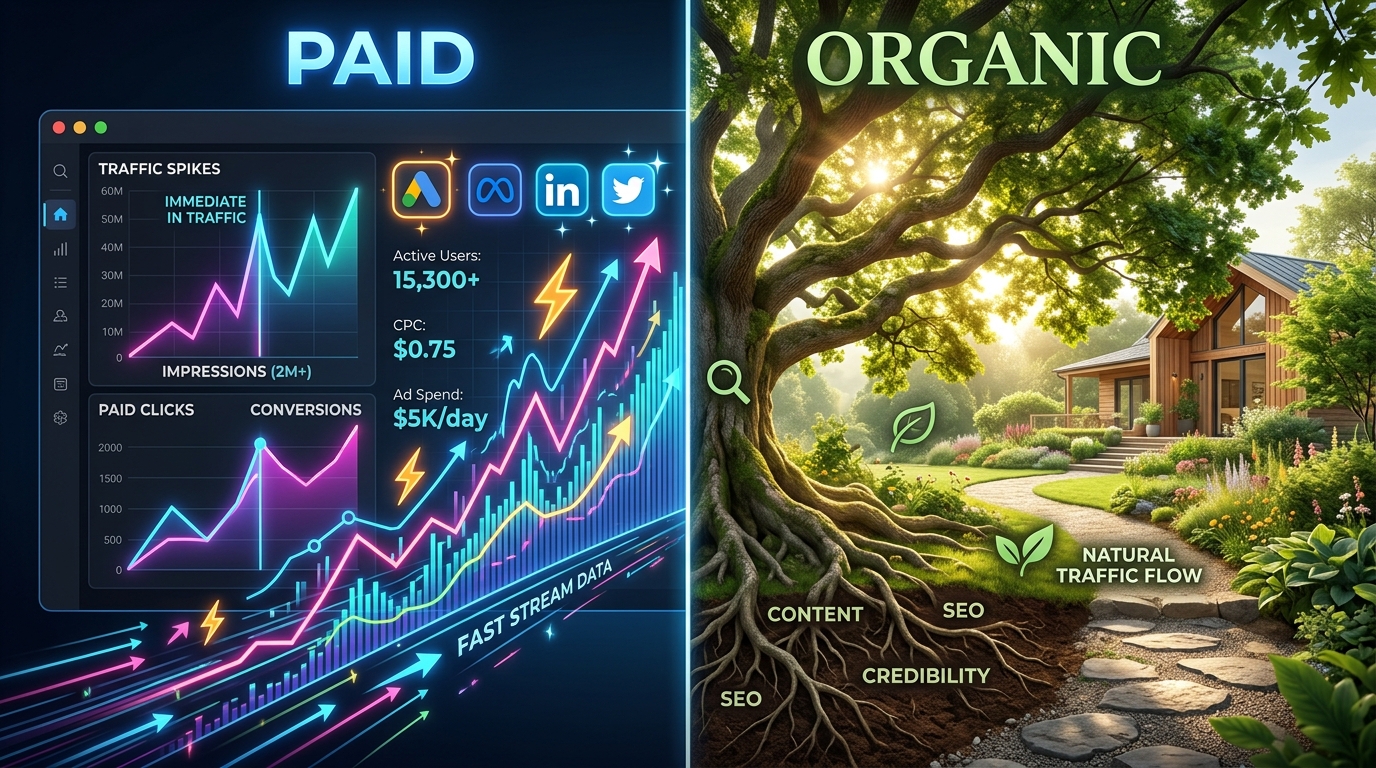
The direct answer: Paid leads are faster but rented. Organic leads are slower but compounding. The honest comparison is not cost per lead — it is cost per closing, measured over time. A $50 lead that converts at 1% costs $5,000 per closing. A $150 lead that converts at 10% costs $1,500. The “cheap” lead is often the most expensive thing you will ever buy.
What this means in practice:
-
Paid leads deliver speed and volume but stop the moment your spend stops. Platform dependency is the hidden tax.
-
Organic leads take 6–12 months to mature but compound, lowering your blended cost per closing over time.
-
Speed to lead is the multiplier that determines whether any channel works. Leads answered within 5 minutes are 21× more likely to qualify than leads answered after 30 minutes .
-
Cost per closing — not cost per lead — is the only metric that reveals true channel economics.
-
Referrals and sphere convert at 30–50%, higher than any paid channel.
-
The hybrid allocation is what successful agents actually run: organic as the base, paid as the accelerator.
Why Cost Per Lead Is the Most Misleading Number in Real Estate Marketing
Most agents compare lead sources by cost per lead. That is the wrong number. Cost per lead tells you what you paid to acquire a contact. It does not tell you whether that contact became a client.
The CPL Trap
Zillow Premier Agent leads cost $50–$150 each and convert at 1–3% for most agents. Run the math: that works out to $1,500–$15,000 per closed transaction. A $50 lead sounds cheaper than a $150 lead until you realise the $50 lead closes at 1% and the $150 lead closes at 3%. The cost per closing is identical.
According to REDX data, the average cost per portal lead — Zillow, Google PPC, Realtor.com — hit $181 in 2026, up over 1,100% since 2015 . At the same time, conversion rates on those portals have dropped to 3–5% in most markets today .
The Only Two Metrics That Matter
There are two numbers that determine whether a lead source is viable for your business:
Cost per closing. Total channel spend divided by closed transactions from that channel. The formula: (Ad spend + platform fees + your time value + follow-up costs) ÷ closed transactions.
Hours per closing. The workload multiplier. A channel with a low cost per closing but an impossible time commitment is not actually cheap.
If a lead source cannot be measured on these two numbers, you cannot know whether it works. You are guessing.
What Speed to Lead Does to the Math
The same lead source converts at dramatically different rates depending on how fast you respond. According to InsideSales.com’s analysis of over 15,000 sales leads, leads responded to within 5 minutes are 21× more likely to qualify than leads answered after 30 minutes .
In practical terms:
-
Teams responding within 5 minutes achieve 28% booking rates.
-
Teams waiting 24 hours achieve 10% booking rates.
-
The average real estate agent takes over 15 hours to respond to an online lead, according to Inman’s 2025 Real Estate Technology Survey .
Speed to lead is not a channel problem. It is an operational problem. The same Zillow lead, the same Google Ads lead, the same organic inquiry — they all convert better when answered in minutes, not hours.
Paid Real Estate Leads: Speed, Scale, and the Platform Dependency Tax
Paid leads solve a real problem: volume on demand. They deliver immediate pipeline. They also create immediate dependency.
What Paid Leads Actually Cost
|
Source |
Cost Per Lead |
Conversion Rate |
Cost Per Closing (Est.) |
|
Zillow Premier Agent |
$50–$150 |
1–3% |
$1,500–$15,000 |
|
Paid real estate average |
$20–$200+ |
2–5% |
$400–$10,000 |
|
Google Ads |
$50–$200 |
3–8% |
$625–$6,667 |
|
Meta/Instagram |
$9–$32 |
1–3% |
$300–$3,200 |
Note: Conversion rates vary significantly by market, follow-up speed, and lead quality. Zillow Premier Agent pricing varies by ZIP code — higher-traffic areas cost more than lower-traffic ones. According to LocaliQ’s 2026 benchmark report, the average cost per lead for real estate search ads is $102.51 .
The Speed Race: Why Zillow Leads Are a Time Contest
Zillow leads are shared with 1–3 other agents in most ZIP codes. The first responder wins disproportionately. This creates a specific operational requirement: sub-3-minute first-call response.
If you cannot answer in three minutes, you are paying for leads that are already being worked by someone else. For a deeper look at response time benchmarks, see how quickly realtors should respond to new leads.
Platform Dependency and Contract Risk
Before signing any paid lead contract, establish these three things:
Exclusivity. A shared lead is being worked by other agents at the same time. This changes the value considerably. Exclusive leads cost more but convert better.
Contract length. Six or twelve month minimums are standard. Setup fees are common. The first-year total is higher than twelve times the monthly rate.
Data portability. If the CRM is bundled with the lead contract, find out whether you can export contacts when it ends. If not, you are building your business on rented land.
The day you stop paying, the pipeline stops. No asset remains. No audience. No content. No database you own.
When Paid Leads Make Sense
Paid leads can work. They require specific conditions:
-
You have sub-5-minute response infrastructure in place (automated or human).
-
You have capacity to work high volume.
-
You are entering a new market and need immediate presence.
-
You are running a specific campaign with a deadline (seasonal push, listing launch).
Paid leads fail when:
-
You lack speed-to-lead automation.
-
You treat lead purchase as a substitute for follow-up systems.
-
You are a solo agent with limited capacity and no CRM automation.
If you are evaluating whether a paid lead is actually worth your time, it helps to understand what makes a real estate lead high-quality before you commit budget.
Organic Real Estate Leads: Slow to Start, Impossible to Beat at Maturity
Organic leads are the opposite of paid in almost every way. They are slow, cheap at maturity, and they build something you own. They also require patience that most agents do not have.
The Organic Reality: Timeline and Expectations
Organic lead generation in real estate is a 6–12 month project before it produces consistent volume.
Months 1–2: Discipline, not deals. Setup, content creation, technical SEO. You will not see leads. You will see work.
Months 3–6: Early traction. Some keywords begin to rank. First organic inquiries arrive. Volume is unpredictable.
Months 6–12: Compounding begins. Your content library matures. Rankings stabilise. Lead flow becomes more predictable.
Industry experience suggests real SEO momentum usually starts after 6–7 months in competitive markets like real estate. Sometimes longer.
The Cost Structure That Compounds
Organic has an inverted cost curve. It is expensive in time upfront, then progressively cheaper per lead as your content library compounds.
Industry benchmarks suggest organic leads convert at 5%–14.6%, compared to 2%–5% for paid real estate leads. The reason is simple: prospects who find you through content arrive pre-sold. They have read your market analysis, watched your neighbourhood tour, or used your home valuation tool. They are not comparison shopping. They are choosing you.
If you want to understand how to spot the difference between a browsing lead and a ready-to-act lead, see how to identify high-intent real estate leads.
What Organic Builds That Paid Cannot
Owned assets. Content, rankings, email list, audience. These remain when you stop spending.
Brand equity. Prospects who discover you through content trust you before the first conversation.
Spillover effect. Paid ads convert better when prospects have already seen your organic content. Purchased leads who look you up find proof of expertise instead of a bare rate table.
AI search visibility. As more property journeys begin with AI queries, organic visibility in AI answers becomes a new lead channel. Content optimised for answer engines (AEO) is the organic strategy of 2026 and beyond.
The Organic Requirements
Organic is not passive. It requires consistent work:
Consistency. Regular content production across your website, social platforms, and email. No bursts followed by silence.
Technical foundation. An IDX website you own, Google Business Profile optimisation, local service pages, and content that answers specific questions in your market.
Patience. The first three months produce more learning than leads. Most agents quit before the compounding begins.
Systems. Organic leads require the same speed-to-lead infrastructure as paid. An organic lead that sits unanswered for six hours is a wasted organic lead.
For a full breakdown of how organic fits alongside other channels, see the best real estate lead sources.
Cost Per Closing: The Only Honest Comparison
Here is what the paid vs organic comparison looks like when you use the metric that actually matters:
|
Metric |
Paid Leads |
Organic Leads |
|
Cost per Lead |
$20–$200+ |
Near zero at maturity |
|
Conversion Rate |
2–5% |
5%–14.6% (benchmark) |
|
Time to First Lead |
Same day to 72 hours |
3–6 months |
|
Time to Predictable Flow |
Weeks |
6–12 months |
|
Asset After Spend Stops |
Nothing |
Content, rankings, audience |
Critical caveat: These numbers assume speed-to-lead infrastructure is in place. Without it, both channels underperform dramatically.
The Speed-to-Lead Multiplier
The real divide is not paid vs organic. It is fast follow-up vs slow follow-up.
A lead answered in 5 minutes is worth 21× more than one answered in 30 . The channel is not the problem. The follow-up is.
If your current response time is measured in hours, no lead source will perform. Fix the follow-up first. Then choose your channels. For a practical cadence, see how many times realtors should follow up with a lead.
What This Means for Your Decision
If you have speed-to-lead systems: Paid leads can work for immediate pipeline. Organic leads will work better over time. Run both, with organic as the base.
If you lack speed-to-lead systems: Fix that first. No channel will perform without it. A $50 lead and a $500 lead convert the same when both sit unanswered for six hours: zero.
The Third Path: Referrals and Sphere (The Highest-Converting Channel)
The paid vs organic binary misses the highest-converting lead source in real estate.
The Numbers
According to the 2025 NAR Profile of Home Buyers and Sellers, 41% of buyers found their agent through a referral, and another 18% used an agent they had worked with before . For first-time buyers, 49% selected their agent from their personal network .
For sellers, 66% used an agent who was referred to them .
Why Referrals Are Neglected
Referrals require consistent post-closing nurture. Quarterly check-ins, automated touchpoints, genuine relationship maintenance. This work has no dashboard. It is hard to measure. So most agents neglect it.
The result: 91% of buyers say they would use their agent again, but only 18% actually used an agent they had worked with before . The gap is not service quality. It is follow-up. For a full explanation of how referral leads differ from other lead types, see what are real estate referral leads.
How Referrals Fit the Framework
Referrals are organic in nature — no hard cost per lead — but relationship-dependent. They amplify both paid and organic: prospects who see your content and get a referral convert at the highest rates.
For agents looking to systematise referral generation, platforms like Omni Referrals offer structured referral networks that connect professionals with vetted leads. This is particularly useful for agents who want to build a referral pipeline without relying solely on manual relationship management.
The complete lead portfolio for a sustainable real estate business:
-
Referrals and sphere: The foundation. Highest conversion, no hard cost, compounding over years.
-
Organic: The compounding engine. Builds owned assets and attracts pre-sold prospects.
-
Paid: The accelerator. Speed and volume when you need it, with the discipline to stop when ROI falls.
If you want to turn referral conversations into signed clients, see how to turn real estate leads into clients.
The Hybrid Allocation: How Successful Agents Actually Run Lead Gen
The paid vs organic question has a third answer: both, in the right sequence.
The Phased Allocation Model
|
Phase |
Timeline |
Allocation |
|
Phase 1: Foundation |
Months 1–3 |
Fix speed-to-lead. CRM setup. Begin organic content. Minimal paid. |
|
Phase 2: Acceleration |
Months 3–6 |
Paid for market presence. Organic building. Referral nurture active. |
|
Phase 3: Rebalancing |
Months 6–12 |
Organic begins producing. Reduce paid dependency. Double down on content. |
|
Phase 4: Compounding |
Months 12+ |
Organic carries majority. Paid for campaigns with deadlines. Referrals compounding. |
When Paid Ads Make Sense (Even in a Hybrid Model)
New market entry. Establishing presence while SEO builds.
Seasonal spikes. Spring buying season, fall seller campaigns.
Specific listing pushes. High-margin listings requiring immediate visibility.
Brokerage scale-up. Multi-agent paid pipelines.
The Operational Foundation (Required for All Channels)
-
CRM with instant lead capture. Every inquiry tracked, every source attributed.
-
Sub-5-minute first response. Automated or human. This is non-negotiable.
-
Multi-touch nurture sequence. For leads not ready immediately. Most real estate leads are not ready on day one. Some experts suggest it takes 8 to 12 touches to convert a lead into a sale, but most agents quit after two to three .
-
Attribution tracking. Know which channel actually drove the closing, not just which channel delivered the lead.
For a deeper look at nurturing leads over time, see how to nurture real estate leads. And for a full strategy overview, see the best real estate lead generation strategies for realtors.
Frequently Asked Questions
Are paid real estate leads worth it in 2026?
For agents with sub-5-minute response and high volume capacity, paid leads can work. For solo agents without speed-to-lead systems, they rarely pencil out. Zillow leads convert at 1–3% and cost $50–$150 each, working out to $1,500–$15,000 per closing. The viability depends on your follow-up infrastructure, not the lead source itself.
How much do real estate leads cost?
Paid real estate advertising averages anywhere from $20 to over $200 per lead depending on market and platform. According to LocaliQ’s 2026 benchmark report, the average cost per lead for real estate search ads is $102.51 . Conversion rates typically sit between 2% and 5%. Organic leads at maturity are near zero cost and convert at 5%–14.6% based on industry benchmarks. For state-specific cost data, see how much real estate leads cost in Texas.
Do organic leads convert better than paid?
Yes, at maturity. Industry benchmarks suggest organic leads convert at 5%–14.6% versus 2%–5% for paid real estate leads. The reason: prospects who find you through content arrive pre-sold and with higher intent.
How long does organic lead generation take?
First leads typically arrive in 3–6 months. Industry experience suggests real SEO momentum in competitive markets starts after 6–7 months.
Can I do both paid and organic lead generation?
Yes, and most successful agents do. The optimal sequence: fix speed-to-lead first, build organic as the base, layer paid for speed and campaigns. Let organic carry more load as it matures. For a full monthly system, see how to generate consistent real estate leads every month.
What is speed to lead and why does it matter?
Speed to lead is the time between a lead’s inquiry and your first response. Leads answered within 5 minutes are 21× more likely to qualify than those answered after 30 minutes . The same lead source performs dramatically differently based on response time.
Are Zillow leads worth it?
Zillow leads cost $50–$150 each with 1–3% conversion, working out to $1,500–$15,000 per closing. They work for high-volume agents with sub-3-minute response and structured nurture sequences. For solo agents doing 3–5 closings per month, they rarely pencil out. To understand the alternative, see what are exclusive real estate leads.
The Bottom Line
Neither paid nor organic is universally better. The honest answer:
Paid leads buy speed but create dependency. Viable only with speed-to-lead systems and high volume.
Organic leads build an asset but require patience. Lower cost per closing at maturity.
Referrals and sphere convert higher than both and should be the foundation of any sustainable lead strategy.
The real differentiator is not the channel. It is speed to lead and follow-up systems.
Before deciding between paid and organic, fix your follow-up. A lead answered in 5 minutes is worth 21× more than one answered in 30 . No channel can overcome slow response. Build the systems first. Then choose your channels.
Ready to map your market? A specialist can audit your current lead sources, calculate your true cost per closing, and identify the fastest path to a sustainable pipeline. No sales pressure — just a clear picture of what is working and what is not.
Written by System Administrator
Real Estate Market Analyst & Investment Specialist at iProply.
