Exclusive Real Estate Leads: What "Exclusive" Actually Means, What They Cost, and How to Choose
The Short Answer
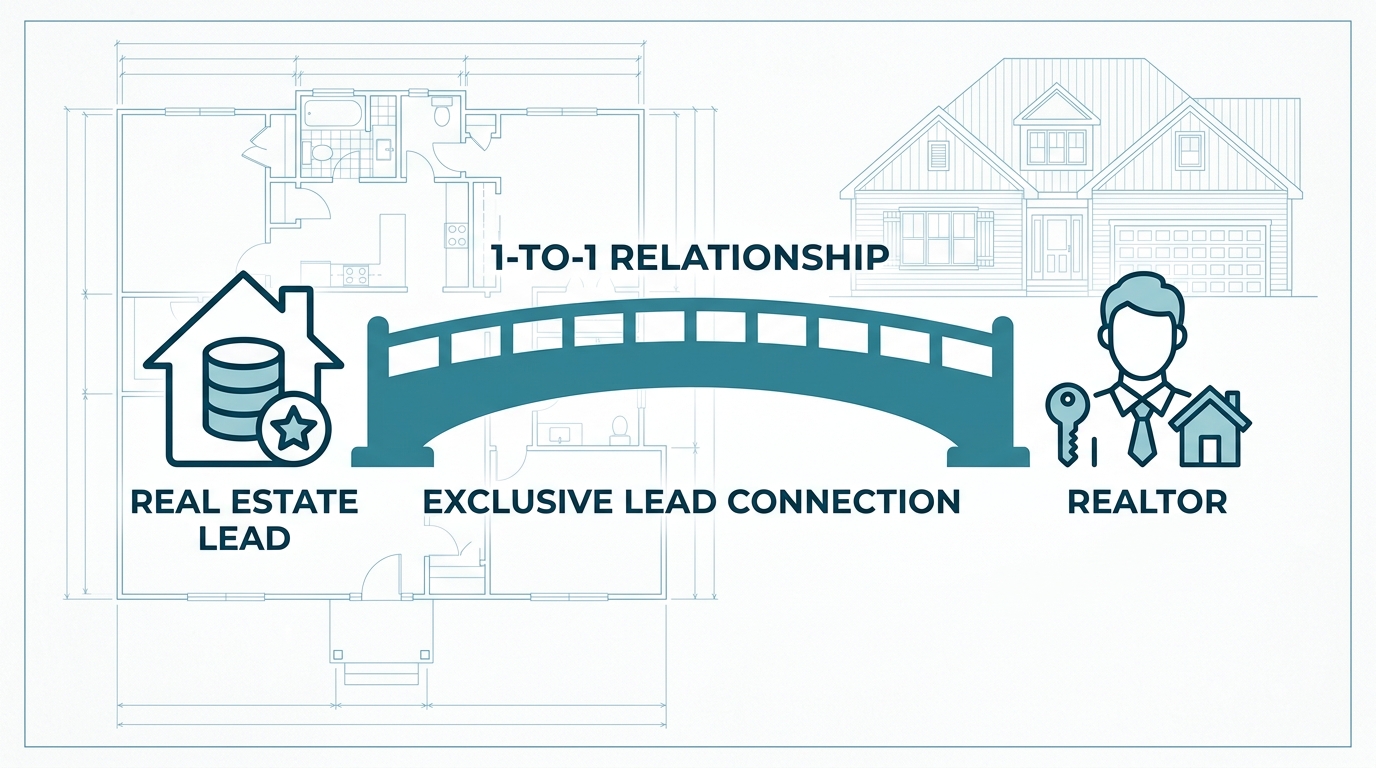
Exclusive real estate leads are prospects sold to only one agent in a given territory. The race to call first disappears. But here is what most agents do not realise until after they sign up: exclusivity describes the transaction, not the customer. An exclusive lead is still typically a raw form-fill. Nobody has verified the person answers their phone, confirmed their timeline, or checked whether they are actually serious about moving.
That distinction changes everything about whether exclusive leads are worth your money.
This guide will show you what "exclusive" actually means across different providers, what pricing and contract terms to expect, how conversion rates compare to shared leads and referrals, and how to decide whether buying exclusive leads or building your own pipeline makes more sense for your business.
What "Exclusive" Actually Means in Real Estate Lead Generation
The word "exclusive" gets used loosely in this industry. A provider might mean you are the only agent receiving that specific lead. Another might mean you have exclusive rights to a ZIP code. A third might mean the lead is "exclusive" for a short time window before it gets redistributed.
To make a smart decision, you need to understand the three fundamentally different products being sold in this market.
The Three Tiers: Shared, Exclusive, and Referral
Shared leads are sold to multiple agents. Three, five, sometimes ten agents receive the same name and phone number at the same moment. You are racing everyone else to the phone. The customer is getting hammered with calls from strangers who all claim to be "the local expert." According to industry reporting, shared leads convert at roughly 0.5 to 1 percent . The National Association of Realtors has published that the average conversion rate for internet leads sits between 0.5% and 1.2% .
Exclusive leads are sold to one agent only. The race disappears. The customer is not fielding four other agents. But here is the critical nuance: exclusive leads are usually still top-of-funnel form-fills. Someone clicked an ad that said "What's your home worth?" and typed in their address. They may be curious. They may be planning to sell in 18 months. They may have forgotten they submitted anything by the time you call . Conversion rates for exclusive leads sit somewhere between 5 and 10 percent according to industry data , though this depends heavily on how well you follow up.
Referrals are a different category entirely. A customer was matched with you through a trusted source. They expect your call by name. They described their need in their own words. You start the conversation already chosen. Referral leads convert at 15 to 25 percent according to industry benchmarks . Pay-at-closing models typically charge a referral fee only when the transaction closes, so your upfront risk is zero .
The progression matters: shared leads are cheap but you are competing. Exclusive leads eliminate the competition but are still unqualified. Referrals are qualified and expected but cost more per closing. Understanding how real estate referral leads work can help you evaluate whether this higher-converting tier is a better fit for your business model.
Why "Exclusive" Does Not Mean "Qualified"
This is the single most important thing to understand before you spend money on exclusive leads.
A qualified lead has verified intent. Someone confirmed the person is actually planning to move, within a realistic timeline, and has the motivation to work with an agent. An exclusive lead has verified distribution. You are the only agent who received it. Those are not the same thing.
Many exclusive lead providers generate leads through Facebook ads offering free home valuations. These ads attract curiosity. Someone who has been vaguely thinking about selling "someday" clicks because it costs nothing to see a number. They are not raising their hand saying "I want to sell my house now." They are browsing.
This is why some agents report calling exclusive leads and getting responses like "Oh, I forgot about that" or "I was just curious about the value." The lead was exclusive. It was not qualified. As one industry analysis put it, exclusivity buys you "freshness and an empty field. It isn't buying a more motivated seller" .
Practical tip: When evaluating any lead provider, ask two separate questions. First: "Will I be the only agent receiving this lead?" Second: "What has been verified about this person's timeline and motivation?" If the provider cannot answer the second question, you are buying exclusivity without qualification. For a deeper look at this process, see how to qualify real estate leads before following up.
What Exclusive Real Estate Leads Cost
Pricing varies significantly based on your market, the provider, the lead type, and the level of exclusivity. Exact rates are not publicly standardised, and you should contact providers directly for current pricing in your area.
That said, understanding the general pricing models helps you evaluate whether a provider's offer makes sense.
Monthly Subscription Models
Most major exclusive lead providers charge a monthly subscription fee. This fee covers access to their platform, a certain volume of leads, and often a CRM or follow-up system. The subscription model gives you predictable costs but also commits you to paying whether the leads perform or not.
Realtor.com's Market VIP program is sold at the brokerage level, and pricing varies by market and competition. According to Clever Real Estate's analysis, monthly costs can start from at least $200, with reports of exclusive leads in popular markets being over $1,000 a month . Market Leader offers individual agent and team plans, with pricing that varies based on your market and the volume of leads you need. BoldLeads charges a monthly platform fee plus a separate advertising budget, meaning your total monthly spend is higher than the headline number suggests.
Pay-Per-Lead Models
Some providers charge per lead rather than a monthly subscription. This gives you more control over volume but less predictability. Pay-per-lead models typically range from $30 to $150 per lead depending on the quality, exclusivity level, and lead type. These models often do not require long-term contracts, which makes them useful for testing before you commit.
Pay-at-Closing Models
A different economic model entirely: you pay nothing upfront and only pay a referral fee when a transaction closes. SOLD.com operates this way, charging a 30–35% referral fee based on your gross commission at closing . Zillow Flex and OpCity also use variations of this model. The trade-off is that your cost per closing is higher when you do close, but you take on zero risk for leads that never convert. To understand how this model works in practice, see pay-at-closing real estate leads.
The critical metric: Do not compare cost per lead. Compare cost per closing. A $30 shared lead that converts at 1 percent costs you $3,000 per client. A $150 exclusive lead that converts at 5 percent costs you $3,000 per client. A $200 referral that converts at 25 percent costs you $800 per client. The headline price tells you almost nothing about the actual economics.
Here is a worked example. If you pay $50 per shared lead and convert at 1 percent, your cost per client is $5,000. If you pay $250 per exclusive lead and convert at 6 percent, your cost per client is approximately $4,167. The exclusive lead costs five times more upfront but actually delivers a lower cost per closing.
Contract Terms and Hidden Commitments
This is where many agents get burned. Exclusive lead providers often require long-term commitments, and the terms are not always obvious from the marketing page.
What to Expect
Most major exclusive lead providers require minimum contract terms. Six months is common. Twelve months is not unusual. Clever Real Estate notes that Realtor.com leads typically require a six or 12-month agreement, meaning you would not be able to cancel easily if you decide to switch . Early termination often comes with fees or requires you to pay out the remainder of the contract.
Market Leader requires a minimum six-month commitment. BoldLeads operates on a six-month minimum with discounts for twelve-month terms. Realtor.com's Market VIP program is sold at the brokerage level and contract terms vary, but agents report annual commitments with limited flexibility.
Pay-per-lead models typically do not have contracts, which gives you flexibility but less predictable volume.
Questions to Ask Before Signing Anything
What is the exact contract length, and what happens if I want to cancel early? Get this in writing. "Month-to-month" and "six-month minimum" are very different commitments.
Is there an auto-renewal clause? Many contracts renew automatically unless you provide notice within a specific window. Calendar the renewal date.
What happens if lead quality drops? If the provider changes their ad strategy or your market becomes saturated, do you have any recourse? Some providers offer volume guarantees. Most do not guarantee quality.
Will I be the only agent receiving these leads? Get the answer in writing. If the answer is anything other than a clear "yes," you are buying a shared lead under an exclusive label.
Can I set a spend cap? Some providers allow you to limit your monthly ad spend. Others do not. Know which one you are signing.
Conversion Reality: Shared vs. Exclusive vs. Referral
The conversion rate difference between these three lead types is the entire reason exclusivity matters. But the numbers need context.
The Data
Shared leads: 0.5 to 1 percent conversion according to industry reporting . The National Association of Realtors has published that the average conversion rate for internet leads is between 0.5% and 1.2% . The race dynamic means the agent who calls first often wins, but "winning" a shared lead still means you are competing against the customer's suspicion that you are just one of many agents calling.
Exclusive leads: 5 to 10 percent conversion according to industry data . The range is wide because it depends entirely on follow-up speed, lead quality, and the provider's targeting. An exclusive lead from a well-targeted campaign with verified intent will convert at the higher end. A raw form-fill from a generic "what's my home worth" ad will sit at the lower end.
Referrals: 15 to 25 percent conversion according to industry benchmarks . The customer expects your call by name. They have already been qualified by the referring source. You start the relationship with trust instead of suspicion.
Why Exclusive Leads Convert Better Than Shared (But Not as Well as Referrals)
Exclusive leads convert better than shared leads because the race disappears. When you are the only agent calling, the customer is not fielding four other calls while you are trying to have a conversation. You control the narrative from the first moment.
But exclusive leads do not convert as well as referrals because the customer did not choose you. They filled out a form. They may not recognize your name when you call. They may have submitted their information on a whim and forgotten about it entirely. You still have to earn the conversation.
The structural difference is trust. A referral arrives with trust built in. An exclusive lead arrives with trust still to be built.
Speed-to-Lead: The Factor That Determines Everything
Research shows that contacting a lead within the first five minutes dramatically improves the chances of conversion. Leads contacted within 5 minutes converted 14 times better than those reached after 24 hours . With shared leads, speed is critical—the first agent to respond usually secures the client. For non-shared leads, agents may have a slightly longer window to connect, but the principle remains the same: trust is built through immediate, proactive communication. For a detailed look at response timing, see how quickly realtors should respond to new leads.
Major Exclusive Lead Providers: What to Know
Provider selection depends on your budget, your market, your follow-up infrastructure, and whether you need buyer leads, seller leads, or both. Here is a practical overview of the major options.
Realtor.com Market VIP
This is a brokerage-level program. Your brokerage purchases exclusive access to a ZIP code, and leads are distributed to agents within that brokerage. Realtor.com describes Market VIP as providing "premium access to high-intent, pre-screened leads that are exclusively dedicated to your brokerage." The Elite Concierge team screens leads for intent to buy, price point, financing, and desired location before live-transferring them to agents.
Pricing varies by market and is not publicly standardised. Clever Real Estate's analysis puts monthly costs starting from at least $200, with reports of exclusive leads in popular markets being over $1,000 a month . Contract terms are typically six to twelve months . Agent experiences are mixed. Some report receiving truly exclusive leads. Others report leads that were supposed to be exclusive but received calls from multiple agents.
Market Leader
Market Leader offers exclusive buyer and seller leads delivered monthly, with built-in CRM and marketing automation tools. It is often positioned as a good fit for newer agents or teams that want a simpler system. Contract terms require a minimum six-month commitment. Lead availability can be limited in competitive ZIP codes.
BoldLeads
BoldLeads specialises in Facebook-based exclusive seller leads. Their ads target homeowners with "What's my home worth?" offers, which means the leads are top-of-funnel and may require twelve to eighteen months of nurturing before they convert. The platform includes automated text follow-up and a basic CRM. Contract terms require a six-month minimum. Pricing includes both a platform fee and an advertising budget.
CINC
CINC is an enterprise-level platform that serves as a complete system for generating exclusive leads, as well as a CRM, marketing automation system, and team management system. The system is less flexible in terms of integration options compared to some competitors. CINC is typically used by teams and brokerages with high-volume lead generation needs.
Pay-at-Closing Models: SOLD.com, OpCity, and Omni Referrals
SOLD.com operates on a pay-at-closing model with no upfront costs. You pay a 30–35% referral fee when a transaction closes . Their leads are primarily seller-focused.
OpCity (ReadyConnect) also uses a pay-at-close model. Agent testimonials indicate appreciation for not paying until closing and value in the pre-qualification process. However, the 30 to 35 percent referral fee significantly reduces net proceeds after broker splits.
Omni Referrals offers a similar pay-at-closing structure where you only pay when a transaction closes. Their model aligns incentives: you invest in the relationship, not in leads that may never convert. For agents who want to test referral-based models without upfront risk, Omni Referrals is worth considering alongside other pay-at-closing services.
REDX and Self-Generation Tools
REDX does not sell exclusive leads. It sells access to prospecting data: expired listings, FSBOs, pre-foreclosures, and direct dial numbers. You use this data to prospect and generate your own exclusive leads. According to REDX data from a study of 2.7 million leads, expired listings convert at approximately 44.4% to a new listing, while FSBOs convert at roughly 31.8% . The economics are different: you are trading time and effort for lead generation instead of money. REDX pricing starts at around $200 per month for their core product.
The Self-Generation Alternative: Building Your Own Exclusive Pipeline
Buying exclusive leads is one path. Generating them yourself is another. The trade-off is money versus time. For a broader view of lead acquisition strategies, see how to get more exclusive real estate leads.
Expired Listings and FSBOs
Expired listings are among the highest-converting prospecting lead types according to REDX data. Nationally, expired listings convert at approximately 44.4% to a new listing within 30 days . These are homeowners who already tried to sell, already worked with an agent, and already understand they need professional help. Your challenge is not convincing them they need an agent. Your challenge is proving you are the right one.
FSBOs convert at roughly 31.8% to a listing within about 46 days according to REDX data . Less competition exists because many agents avoid FSBOs out of fear of the "I don't want an agent" objection. If you can build rapport and provide value, FSBOs can become a reliable pipeline source.
You can access expired and FSBO data through tools like REDX, or through your MLS if you are willing to do the research manually.
Referral Networks
Referrals remain the highest-converting source in real estate. They cost nothing in upfront acquisition, and they convert at rates that paid leads cannot match. The system requires discipline: a structured touch calendar, consistent value delivery, and direct asks for referrals at the right moments. But agents who build referral systems create pipelines that compound over time.
Content and Social Media
Organic content on Instagram, TikTok, and through SEO generates inbound leads that are exclusive by default. The prospect found you. They chose to reach out. Brand familiarity is already established by the time you connect. The timeline is longer, often six to twelve months, but the leads arrive warmer than any purchased lead can be.
Practical consideration: Self-generation requires consistency. You cannot prospect expireds for two weeks and expect a pipeline. The agents who succeed with self-generation treat it as a daily discipline, not a campaign.
Decision Framework: Should You Buy Exclusive Leads or Build Your Own?
The right answer depends on your situation. Here is a framework.
If You Are a New Agent
Start with self-generation. Prospecting expired listings and FSBOs using tools like REDX builds skills, generates leads you own, and does not lock you into a contract you may not be able to afford. Buying exclusive leads requires a follow-up system, a CRM, and cash flow to absorb months of nurturing before a transaction closes. Build those foundations first. For practical alternatives to cold outreach, see how to get real estate leads without cold calling.
If You Are a Solo Agent with an Established Business
You have follow-up infrastructure. You have a CRM. You understand your market. Exclusive lead providers can work for you if you treat them as one channel among several, not as your entire pipeline. Consider starting with a pay-per-lead model to test before committing to a six-month subscription. Track cost per closing, not cost per lead, and cut any provider that does not produce. For a comparison of options, see best real estate lead sources.
If You Are a Team Leader or Broker
Brokerage-level exclusivity programs like Realtor.com Market VIP or enterprise platforms like CINC can work at scale, but only if you distribute leads effectively and hold agents accountable to follow-up standards. Pilot a single ZIP code before committing to multiple territories. And verify that "exclusive" means what you think it means. Agent reports suggest the term is sometimes applied loosely.
The Single Most Important Question
Ask every provider: "Will I be the only agent receiving this lead?" If the answer is not a clear yes, you are buying a shared lead under an exclusive label. That is not necessarily a dealbreaker, but the price should reflect the reality.
Frequently Asked Questions
Are exclusive real estate leads worth it?
They can be, but only if you have a follow-up system and realistic conversion expectations. Exclusive leads convert at 5 to 10 percent according to industry data, compared to 0.5 to 1 percent for shared leads . But they require fast response times and months of consistent nurturing. The math works when you calculate cost per closing, not cost per lead.
How much do exclusive real estate leads cost?
Pricing varies based on your market, the provider, the lead type, and the exclusivity level. Monthly subscriptions range from entry-level plans starting around $200 per month to premium brokerage-level programs exceeding $1,000 per month in competitive markets . Pay-per-lead models typically range from $30 to $150 per lead. Pay-at-closing models charge a 30–35% referral fee only when a transaction closes . Contact providers directly for current pricing in your market.
What does "exclusive" actually mean?
It means the lead is sold to only one agent. It does not mean the lead is qualified, verified, or ready to transact. An exclusive lead is typically a top-of-funnel form-fill. The person may have submitted their information on a whim and may not be planning to move for months .
Do exclusive leads convert better than shared leads?
Yes. Industry data shows exclusive leads convert at roughly 5 to 10 percent compared to 0.5 to 1 percent for shared leads . But referrals convert at 15 to 25 percent, so neither purchased lead type matches the conversion rate of a trusted referral .
Can I get exclusive leads without a contract?
Some pay-per-lead models offer no-contract options. Monthly subscription providers typically require minimum contract terms. Market Leader and BoldLeads operate on six-month minimums. If contract flexibility matters to you, ask specifically about termination terms before signing.
How do I generate exclusive leads myself?
Expired listings, FSBOs, referrals, and organic content generate leads that are exclusive by default. Expired listings convert at roughly 44.4 percent to a listing, and FSBOs at roughly 31.8 percent according to REDX data from a study of 2.7 million leads . Tools like REDX provide prospecting data starting at around $200 per month. For a consistent system, see how to generate consistent real estate leads every month.
What is the most important question to ask a lead provider?
"Will I be the only agent receiving this lead?" Get the answer in writing. If the answer is not a clear yes, you are buying a shared lead under an exclusive label. That is not necessarily a dealbreaker, but you should price it accordingly.
What is the difference between exclusive leads and referrals?
An exclusive lead is sold to one agent but is still typically a raw form-fill with no verified intent. A referral is a recommendation from a source the customer trusts, where the customer expects your call by name and has described their need in their own words. Referrals convert at 15 to 25 percent compared to 5 to 10 percent for exclusive leads .
The Bottom Line
Exclusive real estate leads solve a real problem. The race to the phone that defines shared leads creates a terrible experience for the customer and a stressful one for the agent. Exclusivity eliminates that race.
But exclusivity alone does not guarantee quality. You are buying solitude, not certainty. The lead is yours and only yours, but it is still typically a raw form-fill that requires fast follow-up, consistent nurturing, and realistic expectations about conversion timelines. Understanding what makes a real estate lead high quality helps you evaluate providers more effectively.
The agents who succeed with exclusive leads treat them as one channel in a diversified pipeline, not as a magic solution. They track cost per closing, not cost per lead. They ask the hard questions about contracts and qualification before signing. And they continue building the referral relationships that will always convert better than anything money can buy.
If you want to discuss market-specific pricing, contract terms, and availability for your area, speak with our team. We can help you evaluate whether exclusive leads or self-generation makes more sense for your business.
Written by System Administrator
Real Estate Market Analyst & Investment Specialist at iProply.
